
One plant, one ingredient
Cut from the same cold Maine ledges for generations.
Maine Sea Greens is one plant: Ascophyllum nodosum, the knotted wrack that carpets the ledges of the Maine coast between the tide lines. It is a brown seaweed, one of the Fucales, and it is the species that the published research on Ascophyllum describes when it lists iodine, calcium, magnesium, potassium and a long tail of trace elements in the dried plant.2, 8
It is a slow-growing perennial. A single frond can live a decade or more on the same rock, adding a new air bladder each year once it is established, so you can read a plant’s age along its length like rings in a tree; fronds of fifteen years have been recorded, and the holdfast can persist for decades. That slowness matters. The plant is not sprinting through a season; it is sitting in the North Atlantic for years, pulling minerals from seawater and building them into its own tissue, and layering up the compounds it uses to survive sun, cold and surf: the pigment fucoxanthin and the polyphenols called phlorotannins.8, 14
It is harvested so that it regrows. The plant is cut above the holdfast, the root-like grip that anchors it to the rock, and the base is left to send up new growth. That is how the same beds have been cut year after year for generations. It is then Maine wood pellet dried and milled to a fine, dust-soft powder. Nothing is added and nothing is extracted. The label reads “powdered ascophyllum seaweed, nothing else,” because that is the entire recipe.
Whole plant, ground fine. This is the difference between a food and a supplement. An extract concentrates one compound and leaves the rest behind; a tablet delivers an isolated salt. A powder of the whole plant delivers everything the plant made, in the proportions it made them, bound in the fibre it built around them. Researchers who study seaweed minerals point out that this matters: the minerals are held within the plant’s polysaccharide walls, which is why how much the body takes up is measured rather than assumed.2
Why a powder, and why so fine. The grind is the reason it disappears into food. Coarse flakes taste of the sea; a fine powder dissolves into a chowder, a dressing or a pan of eggs and leaves only depth behind. A single small shaker lasts a household for months at the suggested 1/8 to 1/4 teaspoon a day, which is the whole idea: a small, steady habit rather than a dose.
Every jar traces back to the same stretch of coast, the same species, and the same one-line ingredient list.
- Minerals from Macroalgae Origin: Health Benefits and Risks for Consumers. Marine Drugs, 2018. PMC6266857
- Phytochemistry and pharmacological advances of Ascophyllum nodosum: a comprehensive review. 2024. sciencedirect.com
- Cann SA, van Netten JP, van Netten C. Hypothesis: iodine, selenium and the development of breast cancer. Cancer Causes & Control, 2000;11:121–127. PubMed 10710195
The health benefits
A pinch a day is a small habit with a long reach. Here is what brown seaweed brings to the table, point by point, and what the published research says about each.
Energy and metabolism. The thyroid gland sets the pace of the whole body, and it cannot make its hormones without iodine. The National Institutes of Health lists seaweed among the richest natural food sources of iodine and sets an adult daily need of 150 micrograms.1 In a 2014 clinical study, women with low iodine intake who took half a gram of dried Ascophyllum nodosum a day for two weeks moved from insufficient to adequate iodine status, as measured in their urine.3 A pinch in the pot is how the sea delivers it: as food, not a pill.
Digestion. The fibre in brown seaweed is not the fibre in bran. Alginate and fucoidan are gel-forming polysaccharides that pass through the stomach and small intestine largely intact and reach the colon, where resident bacteria ferment them into short-chain fatty acids, the compounds the cells of the colon use as fuel.4 In a simulated-digestion study, a fucoidan extract survived the upper gut better than inulin, the fibre most often sold as a prebiotic, and shifted the balance of human gut bacteria toward butyrate producers.5 Phlorotannin extracts from Fucus, a close cousin of Ascophyllum, did something similar.6, 7
Immune balance. Fucoidan is the compound in brown seaweed most studied for its role in immune function; a 2011 review counted a three-fold rise in fucoidan research in a decade and catalogued its effects on immune cells and signalling.12 Much of the gut’s immune tissue sits in the colon, which is exactly where seaweed fibre is fermented.4
Bones, skin, hair and nails. Calcium, magnesium and zinc are all present in the plant, and each has a settled role in the body: calcium and magnesium in the structure of bone, zinc in the renewal of skin and in the keratin of hair and nails.19, 21, 17 What is unusual about seaweed is that they arrive together, in plant form, alongside the broad trace spectrum of seawater.2
Less salt. Brown seaweed carries free glutamate, the amino acid behind the taste called umami. Glutamate deepens the flavour of whatever it is cooked into, which is why a pinch makes meat read meatier and broth read deeper, and why most people find they reach for the salt shaker less.
Small doses. Real impact. None of this asks for a change in how you eat, only a change in what you season with. The suggested amount is 1/8 to 1/4 teaspoon a day, added with the salt and pepper before cooking. It is a habit that fits into everyday cooking, and one the research behind it supports one point at a time.
- National Institutes of Health, Office of Dietary Supplements. Iodine: Fact Sheet for Health Professionals. ods.od.nih.gov
- Combet E, et al. Low-level seaweed supplementation improves iodine status in iodine-insufficient women. British Journal of Nutrition, 2014. cambridge.org
- Seaweed polysaccharides as multifunctional biotherapeutics in modulating gut microbiome, metabolic disorders and beyond: a review. PubMed 42297164
- Human gut microbiome modulation and butyrogenic effects of fucoidan from Sargassum binderi. International Journal of Biological Macromolecules. PubMed 41106736
- Impact of Phlorotannin Extracts from Fucus vesiculosus on Human Gut Microbiota. Marine Drugs, 2021. PMC8306378
- The Prebiotic Effect of Australian Seaweeds on Commensal Bacteria and Short Chain Fatty Acid Production in a Simulated Gut Model. Nutrients, 2022. PMC9146517
- Fitton JH. Therapies from Fucoidan; Multifunctional Marine Polymers. Marine Drugs, 2011;9:1731–1760. PMC3210604
- National Institutes of Health, Office of Dietary Supplements. Magnesium: Fact Sheet for Health Professionals. ods.od.nih.gov
- National Institutes of Health, Office of Dietary Supplements. Calcium: Fact Sheet for Health Professionals. ods.od.nih.gov
- National Institutes of Health, Office of Dietary Supplements. Zinc: Fact Sheet for Health Professionals. ods.od.nih.gov
- Minerals from Macroalgae Origin: Health Benefits and Risks for Consumers. Marine Drugs, 2018. PMC6266857
Colloidal & trace minerals
A mineral supplement is ground rock or an isolated salt. Seaweed is neither. Over years of growth, the plant draws minerals out of open seawater and builds them into its own tissue, bound within the polysaccharide walls of its cells. That is the colloidal, food-held form: minerals suspended in the plant matrix rather than sitting loose as a powder or a pill.
What the research finds in the plant. A 2018 review in Marine Drugs on minerals of macroalgae origin documents the pattern across brown seaweeds: high iodine, meaningful calcium, magnesium and potassium, and a wide range of trace elements including iron, zinc, copper, manganese and selenium.2 A 2024 review devoted to Ascophyllum nodosum reports the same profile for this species specifically, with calcium, magnesium and iodine singled out.8
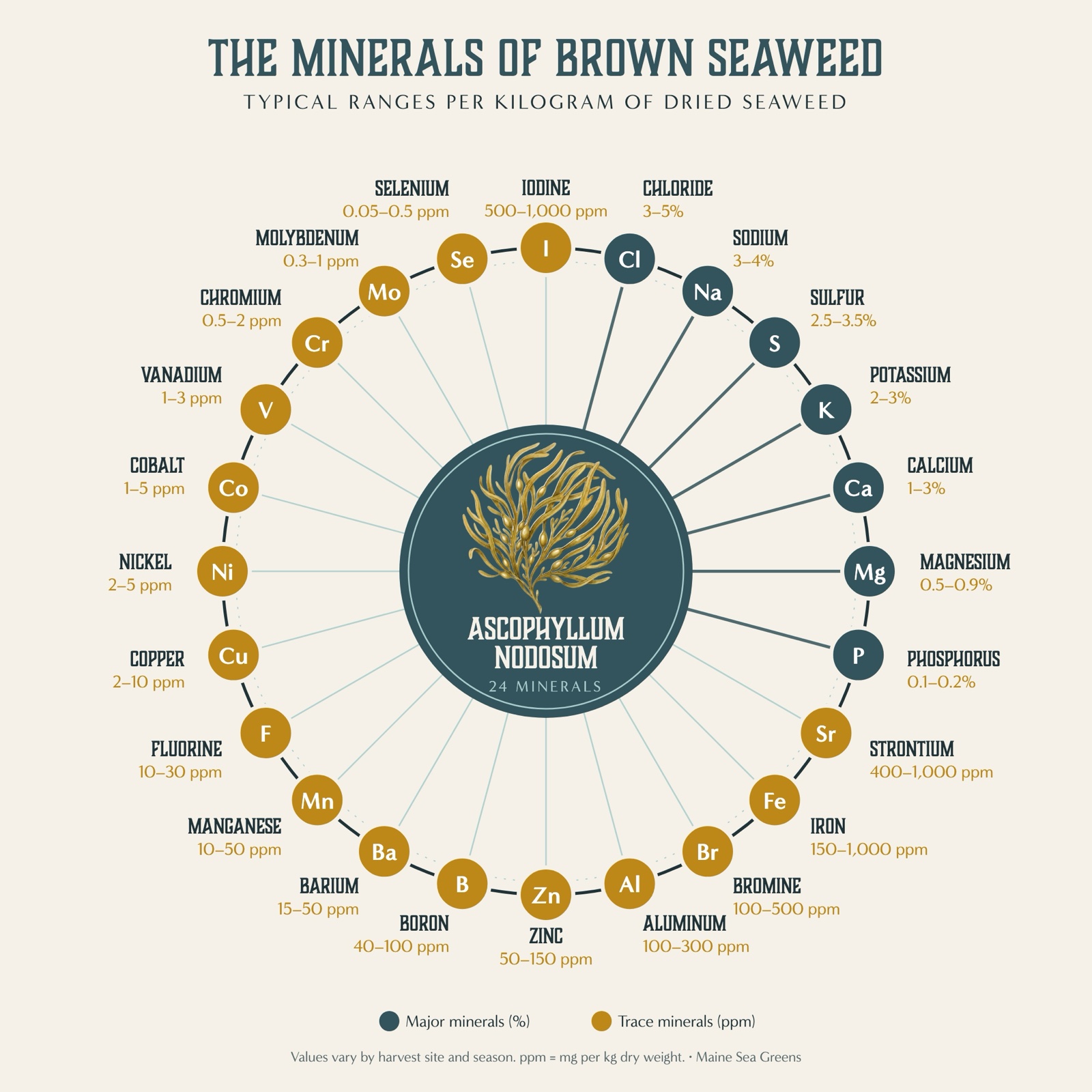
The structural minerals. Calcium, magnesium and potassium are present in the plant matrix rather than as added carbonate. Calcium is the mineral of bone and teeth; magnesium takes part in more than three hundred enzyme reactions and in the making of protein and bone; potassium is the mineral that keeps fluid balance, nerve signalling and muscle contraction working.21, 19, 20 Most modern diets fall short on magnesium and potassium in particular, according to the National Institutes of Health.19, 20
The cofactors. Copper, zinc, manganese, iron and selenium are the trace minerals enzymes cannot work without. Zinc alone is needed by hundreds of enzymes, and the body has no specialised way to store it, so it has to arrive with food.17 Selenium is built into the enzymes that put thyroid hormone to work and into the body’s own antioxidant defences.18 Brown seaweed carries all of them, in small amounts, together.2
Why the amounts are small and steady. Because the plant did the gathering, a pinch delivers trace amounts: present, measurable, never in supplement quantities. Researchers who study seaweed minerals note that the same fibre that holds the minerals can also moderate how much the body takes up, which is why absorption is measured rather than assumed. In the one clinical study on Ascophyllum iodine, about a third of the iodine in the seaweed was taken up, compared with more than half from a potassium-iodide tablet.2, 3
Trace means trace. That is the point of a seasoning and the reason it is safe to use every day. You are not taking a dose; you are seasoning food with a plant that grew in mineral-rich water, and letting the minerals come along with dinner.
- Minerals from Macroalgae Origin: Health Benefits and Risks for Consumers. Marine Drugs, 2018. PMC6266857
- Phytochemistry and pharmacological advances of Ascophyllum nodosum: a comprehensive review. 2024. sciencedirect.com
- National Institutes of Health, Office of Dietary Supplements. Calcium: Fact Sheet for Health Professionals. ods.od.nih.gov
- National Institutes of Health, Office of Dietary Supplements. Magnesium: Fact Sheet for Health Professionals. ods.od.nih.gov
- National Institutes of Health, Office of Dietary Supplements. Potassium: Fact Sheet for Health Professionals. ods.od.nih.gov
- National Institutes of Health, Office of Dietary Supplements. Zinc: Fact Sheet for Health Professionals. ods.od.nih.gov
- National Institutes of Health, Office of Dietary Supplements. Selenium: Fact Sheet for Health Professionals. ods.od.nih.gov
- Combet E, et al. Low-level seaweed supplementation improves iodine status in iodine-insufficient women. British Journal of Nutrition, 2014. cambridge.org
Thyroid, reproductive system and brain
The thyroid cannot make its hormones without iodine. It is structural, not a helper: the two thyroid hormones are built from iodine atoms, and without enough of it the gland has nothing to work with. Those hormones set the pace of nearly every cell in the body, from how fast you burn energy to how warm you feel.1
Other tissues concentrate it too. The ovaries, the breast and the prostate all take up and hold iodine, and the developing brain depends on it: iodine is the one nutrient for which the National Institutes of Health says a shortfall in pregnancy can affect a child’s cognitive development. Needs rise from 150 micrograms a day for adults to 220 in pregnancy and 290 while nursing.1
Where iodine comes from. Most inland diets get their iodine from iodised salt alone. A coastal diet gets it from the sea. The National Institutes of Health names seaweed as one of the best natural food sources, and brown seaweeds such as kelp and Ascophyllum are the most concentrated of all.1, 2
It is bioavailable from seaweed. This has been tested directly in people. In a 2014 study in the British Journal of Nutrition, healthy women with low iodine intake took 0.5 grams of dried Ascophyllum nodosum a day for two weeks. Their urinary iodine, the standard marker of iodine status, rose from an insufficient 78 micrograms per litre to an adequate 140. The researchers also found that iodine from the seaweed was taken up more gradually than from a potassium-iodide tablet, at about a third of the dose, which the authors noted as a gradual way to raise iodine status.3
Why the amount stays small. Because seaweed is so concentrated, a little goes a long way. The suggested amount stays at 1/8 to 1/4 teaspoon a day, and the National Institutes of Health sets an adult upper limit of 1,100 micrograms of iodine a day.1 The plant’s iodine varies with season and harvest, so the sensible rule is to treat the shaker like salt, not like a supplement.
As food, not a pill. A pinch in the pot is how coastal people have taken their iodine for as long as there have been coastal people. It comes with the plant’s selenium, which the thyroid needs to activate the hormone iodine builds, and with everything else the plant made.18 If you have a thyroid condition or take thyroid medication, talk with your doctor before adding seaweed to your diet.
- National Institutes of Health, Office of Dietary Supplements. Iodine: Fact Sheet for Health Professionals. ods.od.nih.gov
- Minerals from Macroalgae Origin: Health Benefits and Risks for Consumers. Marine Drugs, 2018. PMC6266857
- Combet E, et al. Low-level seaweed supplementation improves iodine status in iodine-insufficient women. British Journal of Nutrition, 2014. cambridge.org
- National Institutes of Health, Office of Dietary Supplements. Selenium: Fact Sheet for Health Professionals. ods.od.nih.gov
Teeth, gums and saliva
Teeth are built from minerals. Enamel is the hardest substance in the body and it is almost entirely mineral: calcium and phosphate, with magnesium alongside. The body cannot make those minerals; it has to eat them, and the National Institutes of Health lists calcium and magnesium among the nutrients the skeleton and teeth depend on throughout life.21, 19 Brown seaweed carries both in the plant’s own matrix.2
Coastal cultures chewed seaweed long before anyone asked why. From Japan to Ireland to the Maine coast, dried seaweed was a chewing food, a mineral supply and a between-meals habit. Modern research is only now catching up with the reasons.
Saliva is the mouth’s own rinse and buffer. Chewing mineral-rich foods keeps saliva flowing, and saliva does three things at once: it washes food from the teeth, it neutralises the acids that form after eating, and it carries dissolved calcium and phosphate back to the enamel surface. The same minerals that build teeth are the ones saliva uses to buffer the mouth after a meal.21
What the laboratory studies show. Researchers have begun testing brown-seaweed extracts against the bacteria that build plaque on teeth. In a 2024 study, an extract of the brown alga Padina boergesenii reduced biofilm formation by Streptococcus mutans, the main plaque-forming bacterium, by up to 93 percent in the test tube, without killing the bacteria outright; the active compounds turned out to be ordinary fatty acids found across brown seaweeds.9 A review in the Indian Journal of Dental Research gathered similar findings from several marine algal extracts against common oral bacteria.10
What that does and does not mean. These are laboratory findings on concentrated extracts. No study has measured what a pinch of seasoning does in the mouth at mealtime, and this page makes no such claim. What the research does support is simpler: teeth are mineral, seaweed is a mineral-rich food, and chewing it keeps the mouth’s own defences moving.
A habit, not a treatment. Coastal Maine families kept dried brown seaweed in the kitchen for exactly this kind of quiet, daily mineral supply: the same pinch, at the same meals, over months and years. That is the frame to hold it in.
- National Institutes of Health, Office of Dietary Supplements. Calcium: Fact Sheet for Health Professionals. ods.od.nih.gov
- National Institutes of Health, Office of Dietary Supplements. Magnesium: Fact Sheet for Health Professionals. ods.od.nih.gov
- Minerals from Macroalgae Origin: Health Benefits and Risks for Consumers. Marine Drugs, 2018. PMC6266857
- Anticariogenic activity of marine brown algae Padina boergesenii and its active components towards Streptococcus mutans. 2024. PMC11625749
- Efficacy of Marine Algal Extracts against Oral Pathogens: a review. Indian Journal of Dental Research. ijdr.in
The reproductive system
The reproductive system runs on the thyroid, and the thyroid runs on iodine. The ovaries concentrate iodine, and the thyroid hormone built from it sets the pace of the whole reproductive cycle. The National Institutes of Health notes that iodine needs rise sharply in pregnancy and nursing, to 220 and 290 micrograms a day, because a developing brain depends on it.1
Selenium puts iodine to work. The enzymes that activate thyroid hormone are selenium-dependent, so iodine and selenium work as a pair. Selenium is also built into the antioxidant enzymes that protect reproductive tissue.18 Brown seaweed carries both minerals together, in the same plant.2
Zinc, for men in particular. Zinc is the trace mineral most closely tied to normal reproductive function in men; it is concentrated in the prostate and seminal fluid, and the National Institutes of Health describes it as essential for normal growth and development through pregnancy, childhood and adolescence. The body cannot store zinc, so it has to arrive with food, regularly.17
Magnesium and the rest. Magnesium takes part in the making of protein and in the regulation of nerve and muscle function, and most adults in the United States take in less than the recommended amount.19 Seaweed supplies it alongside calcium, potassium and the trace spectrum of seawater.2, 8
In a form the body recognises. All of this arrives as food, in the amounts a pinch provides, held in the plant’s own fibre rather than as an isolated salt. That is the difference between seasoning with a mineral-rich plant and taking a supplement, and it is why the amounts stay small and the habit stays daily.
Please read. Seaweed is so concentrated in iodine that pregnancy is exactly the time to be careful with amounts. The suggested 1/8 to 1/4 teaspoon a day is deliberately small, and the National Institutes of Health sets an upper limit of 1,100 micrograms of iodine a day.1 If you are planning a pregnancy, pregnant or nursing, talk with your doctor about iodine before adding seaweed to your diet.
- National Institutes of Health, Office of Dietary Supplements. Iodine: Fact Sheet for Health Professionals. ods.od.nih.gov
- National Institutes of Health, Office of Dietary Supplements. Selenium: Fact Sheet for Health Professionals. ods.od.nih.gov
- Minerals from Macroalgae Origin: Health Benefits and Risks for Consumers. Marine Drugs, 2018. PMC6266857
- National Institutes of Health, Office of Dietary Supplements. Zinc: Fact Sheet for Health Professionals. ods.od.nih.gov
- National Institutes of Health, Office of Dietary Supplements. Magnesium: Fact Sheet for Health Professionals. ods.od.nih.gov
- Phytochemistry and pharmacological advances of Ascophyllum nodosum: a comprehensive review. 2024. sciencedirect.com
What fucoidan does
Found only in brown seaweed, fucoidan is the plant’s most studied compound. A 2011 review in Marine Drugs counted a three-fold rise in fucoidan papers between 2000 and 2010, and the pace has not slowed; thousands of studies now concern it, more than any other seaweed compound.12
What it is. Fucoidan is a sulfated polysaccharide: a long chain of the sugar fucose, built into the cell walls of brown seaweed, with sulfate groups attached along its length. Those sulfate groups are what make it unusual. They let it hold water, they keep human digestive enzymes from breaking it down, and they are the reason so many of its biological activities exist at all.12
What it does in the gut. Because it resists digestion, fucoidan reaches the colon intact. There, resident bacteria ferment it into short-chain fatty acids, the compounds the cells of the colon use as their main fuel.4 In a recent simulated-digestion study, a fucoidan extract survived the upper digestive tract better than inulin, the fibre most often sold as a prebiotic, and shifted the balance of human gut bacteria toward butyrate producers.5 Australian and European seaweed studies report the same pattern: more beneficial bacteria, more short-chain fatty acids.6, 7
What it does for immune balance. The 2011 review catalogues fucoidan’s effects on immune signalling, on the molecules that guide immune cells to where they are needed, and on the body’s complement system.12 Much of the body’s immune tissue sits in the wall of the gut, which is precisely where seaweed fibre is fermented, so the two roles are connected.4
What else is studied. The same review describes fucoidan research on circulation and blood flow, on the stomach lining, and on the uptake and safety of fucoidan in people, and notes that fucoidan from different seaweeds behaves differently because its structure varies from species to species.12 Ascophyllum nodosum is among the richest sources.8
Why old plants matter. Fucoidan accumulates with age, so mature, slow-grown fronds carry the most of it. A plant that has sat on the same ledge for a decade has been building fucoidan the whole time, and that patience ends up in the jar. Cooking does not remove it.
A note on blood thinners. Fucoidan has anticoagulant activity in laboratory studies, measured with purified fucoidan at concentrations far above what a seasoning delivers.12 If you take a blood-thinning medication or have a clotting disorder, talk with your doctor before adding seaweed to your diet.
- Fitton JH. Therapies from Fucoidan; Multifunctional Marine Polymers. Marine Drugs, 2011;9:1731–1760. PMC3210604
- Seaweed polysaccharides as multifunctional biotherapeutics in modulating gut microbiome, metabolic disorders and beyond: a review. PubMed 42297164
- Human gut microbiome modulation and butyrogenic effects of fucoidan from Sargassum binderi. International Journal of Biological Macromolecules. PubMed 41106736
- Impact of Phlorotannin Extracts from Fucus vesiculosus on Human Gut Microbiota. Marine Drugs, 2021. PMC8306378
- The Prebiotic Effect of Australian Seaweeds on Commensal Bacteria and Short Chain Fatty Acid Production in a Simulated Gut Model. Nutrients, 2022. PMC9146517
- Phytochemistry and pharmacological advances of Ascophyllum nodosum: a comprehensive review. 2024. sciencedirect.com
Seaweed and the gut
The fibre in brown seaweed is not the fibre in bran. It is a family of gel-forming marine polysaccharides your gut bacteria treat as food.
Two fibres, both unusual. Alginate and fucoidan are the main fibres of brown seaweed. Neither is broken down by human digestive enzymes, so both pass through the stomach and small intestine largely intact and arrive in the colon whole. A recent review describes seaweed polysaccharides as promising prebiotics for exactly this reason: they resist the upper gut and reach the bacteria that can use them.4
That is what a prebiotic is. A probiotic adds bacteria; a prebiotic feeds the ones already there. In the colon, resident bacteria ferment seaweed fibre into short-chain fatty acids, chiefly butyrate, acetate and propionate, which the cells lining the colon use as their main fuel.4
What the studies show. In a simulated-digestion study, a fucoidan extract survived the upper digestive tract better than inulin, the fibre most often sold as a prebiotic, and in human fecal fermentation it shifted the bacterial community toward butyrate-producing species.5 A separate study using phlorotannin extracts from Fucus vesiculosus, a close relative of Ascophyllum, reported changes in human gut bacteria in the same direction.6 Work on Australian seaweeds in a simulated gut model found more beneficial bacteria and more short-chain fatty acid production.7
Viscous fibre slows things down. Alginate forms a gel with water. In the stomach that gel slows the emptying of a meal, which is felt as a longer sense of fullness afterwards. Most people notice it as a quieter appetite between meals rather than anything dramatic, which is the point of a seasoning.
Whole food, not isolated fibre. Because the fibre arrives inside the whole plant rather than as an extracted powder, it comes with the minerals and polyphenols the plant built around it. Researchers who study seaweed minerals note that the fibre and the minerals travel together, and that this is part of why seaweed behaves as a food rather than as a supplement.2
What that does and does not mean. Most of this is laboratory and animal research, and the amounts studied were extracts rather than a pinch in a meal. Human trials of seaweed fibre are still early. What the research does establish is the mechanism: these fibres reach the colon, and the colon’s bacteria know what to do with them.
- Seaweed polysaccharides as multifunctional biotherapeutics in modulating gut microbiome, metabolic disorders and beyond: a review. PubMed 42297164
- Human gut microbiome modulation and butyrogenic effects of fucoidan from Sargassum binderi. International Journal of Biological Macromolecules. PubMed 41106736
- Impact of Phlorotannin Extracts from Fucus vesiculosus on Human Gut Microbiota. Marine Drugs, 2021. PMC8306378
- The Prebiotic Effect of Australian Seaweeds on Commensal Bacteria and Short Chain Fatty Acid Production in a Simulated Gut Model. Nutrients, 2022. PMC9146517
- Minerals from Macroalgae Origin: Health Benefits and Risks for Consumers. Marine Drugs, 2018. PMC6266857
Fucoxanthin for health
Fucoxanthin is the pigment that makes brown seaweed brown. It is a carotenoid, a cousin of the pigments in carrots and tomatoes, but with a structure found in brown algae and diatoms and almost nowhere else in the diet. A 2012 review in Marine Drugs calls it “a treasure from the sea” and lays out why: it is one of the most abundant carotenoids on earth, and one of the most studied for its biological activity.22
Where it sits in the plant. Fucoxanthin lives inside the plant’s light-harvesting apparatus, where it captures the blue-green light that reaches underwater and passes the energy along to chlorophyll. Beside it sit the phlorotannins, the polyphenols brown seaweed builds to survive sun, cold and surf. Both survive drying and milling, and both are documented in Ascophyllum nodosum specifically.8, 14
What the research studies. The 2012 review gathers the laboratory and animal work on fucoxanthin: its antioxidant activity, its role in metabolism and body composition, and the way the body converts it after a meal into related compounds that carry on its effects.22 A 2023 study on Ascophyllum extracts found that the plant’s phlorotannins are strong antioxidants and, in the test tube, inhibit the enzymes that break starch down into sugar.14
It is fat-soluble. Like every carotenoid, fucoxanthin travels best in a dish with a little oil, butter or fish: a chowder, a dressing, a pan of eggs. That is one more reason to cook it in rather than sprinkle it on a finished plate.22
The colour tells you it is there. The dull olive colour of the powder is fucoxanthin, still present after drying, the surest sign it survived the trip from ledge to jar. A bright grass-green powder is a different plant, or a bleached one. Heat and light break some of it down, but studies of blanched and cooked brown seaweed find much of it survives ordinary cooking, and the minerals all do.
What that does and does not mean. Nearly all fucoxanthin research uses concentrated extracts at doses far above what a seasoning provides. A pinch of seaweed is a food that happens to contain the pigment, not a fucoxanthin supplement, and this page makes no claim beyond that.
- D’Orazio N, et al. Fucoxantin: A Treasure from the Sea. Marine Drugs, 2012;10:604–616. PMC3347018
- Phytochemistry and pharmacological advances of Ascophyllum nodosum: a comprehensive review. 2024. sciencedirect.com
- Cann SA, van Netten JP, van Netten C. Hypothesis: iodine, selenium and the development of breast cancer. Cancer Causes & Control, 2000;11:121–127. PubMed 10710195
Fucoxanthin and the metabolism
Fucoxanthin is the marine carotenoid most studied for its role in metabolism and body composition. A 2012 review in Marine Drugs devotes a section to it, tracing the laboratory and animal work on how the pigment and the compounds the body makes from it affect the way fat tissue burns energy.22
The human trial. The best-known study is a sixteen-week randomised, double-blind, placebo-controlled trial published in Diabetes, Obesity and Metabolism in 2010. One hundred and fifty-one women took either a placebo or a brown-seaweed extract standardised for fucoxanthin, paired with pomegranate seed oil. The researchers reported changes in body weight, waist measurement and liver fat over the course of the study in the women who took the extract.11 It is reported here as the researchers published it: a study of a concentrated extract at supplement doses, not of a seasoning.
What a seasoning does instead. A pinch of seaweed delivers the same pigment in food amounts, and it delivers it alongside something the extract left behind: the plant’s viscous fibre. Alginate forms a gel in the stomach that slows the emptying of a meal and lengthens the sense of fullness afterwards.4
The enzyme finding. In laboratory tests, the phlorotannins in Ascophyllum nodosum inhibit α-amylase and α-glucosidase, the enzymes that break starch down into sugar. That is a test-tube result on an extract, but it points at the same theme: brown seaweed slows the breakdown and absorption of a starchy meal rather than speeding it up.14
Iodine and the thyroid. Underneath all of it is the thyroid, the gland that sets the body’s metabolic pace, and the thyroid cannot make its hormones without iodine. The National Institutes of Health lists seaweed among the richest food sources, and a 2014 clinical study showed that iodine from Ascophyllum raises iodine status in people who are short of it.1, 3
None of this is a diet claim. It is what a mineral-rich, fibre-rich food does when it replaces some of the salt on the plate: the meal digests more slowly, and the plate carries more of what the body was looking for in the first place.
- D’Orazio N, et al. Fucoxantin: A Treasure from the Sea. Marine Drugs, 2012;10:604–616. PMC3347018
- Abidov M, et al. The effects of Xanthigen in the weight management of obese premenopausal women with non-alcoholic fatty liver disease and normal liver fat. Diabetes, Obesity and Metabolism, 2010;12:72–81. PubMed 19840063
- Seaweed polysaccharides as multifunctional biotherapeutics in modulating gut microbiome, metabolic disorders and beyond: a review. PubMed 42297164
- Cann SA, van Netten JP, van Netten C. Hypothesis: iodine, selenium and the development of breast cancer. Cancer Causes & Control, 2000;11:121–127. PubMed 10710195
- National Institutes of Health, Office of Dietary Supplements. Iodine: Fact Sheet for Health Professionals. ods.od.nih.gov
- Combet E, et al. Low-level seaweed supplementation improves iodine status in iodine-insufficient women. British Journal of Nutrition, 2014. cambridge.org
Fibre, minerals and the heart
Gel-forming fibres bind bile in the gut. Alginate, the main fibre of brown seaweed, belongs to the same class of viscous fibre as the beta-glucan in oats and the soluble fibre in beans. Fibres of this kind form a gel that binds bile acids in the gut so they leave the body rather than being recycled, and the liver draws on cholesterol to make more; that is the mechanism generally described for the link between viscous fibre and cholesterol levels already within the normal range.4 Brown seaweed is one of the few foods, on land or sea, that carries this kind of fibre in quantity.
Potassium and magnesium. These are the two minerals the heart muscle and the blood vessels rely on for normal function, and the two that most modern diets fall short on. The National Institutes of Health describes potassium as essential for fluid balance, nerve signalling and the contraction of muscle, including the heart, and magnesium as important to nerve conduction, muscle contraction and normal heart rhythm.20, 19 Both are present in brown seaweed, held in the plant matrix.2, 8
Fucoidan and blood flow. Fucoidan itself is studied for its effects on circulation. The 2011 review in Marine Drugs describes its activity on blood flow, on the cells that line blood vessels, and on the signalling that guides cells through the bloodstream.12
Less salt on the plate. Cooking with seaweed means reaching for salt less, which most people notice within a week. The free glutamate in the plant deepens flavour, so a dish tastes seasoned with less sodium in it. Fewer shakes of salt and more potassium and magnesium on the plate: that is the everyday version of heart-minded eating, and it costs nothing but a pinch.20
Season the soup, skip the salt. That is the habit. It does not ask for a new diet, only a different shaker beside the stove.
A note on blood thinners. Fucoidan has anticoagulant activity in laboratory studies, measured with purified fucoidan at concentrations far above what a seasoning delivers.12 If you take a blood-thinning medication or have a clotting disorder, talk with your doctor before adding seaweed to your diet.
- Seaweed polysaccharides as multifunctional biotherapeutics in modulating gut microbiome, metabolic disorders and beyond: a review. PubMed 42297164
- National Institutes of Health, Office of Dietary Supplements. Potassium: Fact Sheet for Health Professionals. ods.od.nih.gov
- National Institutes of Health, Office of Dietary Supplements. Magnesium: Fact Sheet for Health Professionals. ods.od.nih.gov
- Minerals from Macroalgae Origin: Health Benefits and Risks for Consumers. Marine Drugs, 2018. PMC6266857
- Phytochemistry and pharmacological advances of Ascophyllum nodosum: a comprehensive review. 2024. sciencedirect.com
- Fitton JH. Therapies from Fucoidan; Multifunctional Marine Polymers. Marine Drugs, 2011;9:1731–1760. PMC3210604
Antioxidants, skin and aging
Fucoxanthin and the phlorotannins are antioxidants. They are the compounds the plant builds to survive sun, cold and surf, and both are documented in Ascophyllum nodosum. A 2023 study of Ascophyllum extracts measured strong antioxidant activity in the plant’s phlorotannins; a 2012 review in Marine Drugs does the same for fucoxanthin.14, 22
What antioxidants do. Every day, ordinary living produces reactive molecules that wear on cells, and skin, being on the outside, takes more of that wear than most tissue. Antioxidants are the compounds that quench those molecules. That is why brown-seaweed extracts now appear in skincare for the appearance of skin: the same defences the plant built for itself against sun and salt are useful on a face.22
From within: zinc. Zinc is the mineral skin uses to renew itself. The National Institutes of Health describes it as essential for the making of protein and DNA, for wound healing and for normal cell division, all of which skin does constantly; the body cannot store zinc, so it has to arrive with food.17 Brown seaweed carries it in the plant matrix.2
Selenium and the trace spectrum. Selenium is built into the body’s own antioxidant enzymes, the ones that protect cells from the inside.18 Alongside it come copper, manganese and the broad trace spectrum of seawater, in the small, steady amounts a pinch provides.2
Hair and nails. Hair and nails are built from the same keratin, and they show what the diet was doing months earlier, because that is how long they take to grow out. Zinc and the sulfur-bearing minerals are what that keratin is made with.17
The result is not a cream. It is a pinch, every day, from the inside. The sea has always been a spa ingredient; here it is an ingredient in dinner.
What that does and does not mean. The antioxidant findings come from laboratory tests on extracts, and this page makes no claim that a seasoning changes the skin. What the research supports is that the plant is rich in antioxidants and in the minerals skin, hair and nails are built from.
- Cann SA, van Netten JP, van Netten C. Hypothesis: iodine, selenium and the development of breast cancer. Cancer Causes & Control, 2000;11:121–127. PubMed 10710195
- D’Orazio N, et al. Fucoxantin: A Treasure from the Sea. Marine Drugs, 2012;10:604–616. PMC3347018
- National Institutes of Health, Office of Dietary Supplements. Zinc: Fact Sheet for Health Professionals. ods.od.nih.gov
- Minerals from Macroalgae Origin: Health Benefits and Risks for Consumers. Marine Drugs, 2018. PMC6266857
- National Institutes of Health, Office of Dietary Supplements. Selenium: Fact Sheet for Health Professionals. ods.od.nih.gov
A note on blood thinners
Fucoidan has anticoagulant activity in laboratory studies. It can slow clotting in a test tube, and this is one of the longest-known properties of the compound. The 2011 review in Marine Drugs describes it in detail: sulfated polysaccharides like fucoidan resemble heparin in structure, and purified fucoidan fractions interfere with several steps of the clotting cascade.12
How the effect was measured. These studies use purified fucoidan, often at concentrations far above what a seasoning delivers, and mostly in the laboratory or in animals. The review notes that fucoidan from different seaweeds varies in strength, and that how much fucoidan the body takes up from food is still being worked out.12 At pinch amounts, this is not a concern for most people. It is listed here because it is real, and because you should know what is on your plate.
Who should ask first. If you take a blood-thinning medication, have a clotting disorder, or are preparing for surgery, talk with your doctor before adding seaweed to your diet. The same caution applies to anyone already combining several foods or supplements known to affect clotting.
Iodine deserves the same respect. Brown seaweed is the most concentrated food source of iodine there is. That is a benefit at a pinch and a problem at a spoonful. The National Institutes of Health sets an adult upper limit of 1,100 micrograms a day, and warns that too much iodine can affect the thyroid just as too little can.1 Keep to the suggested 1/8 to 1/4 teaspoon a day. If you have a thyroid condition or take thyroid medication, ask your doctor first.
Potassium and the kidneys. Seaweed carries potassium, which is a benefit for most people and a caution for anyone with kidney disease or on a potassium-sparing medication, because those kidneys cannot clear it as easily.20
Pregnancy, nursing and infants. Iodine needs rise in pregnancy and nursing, which is exactly why amounts matter then. Talk with your doctor before adding seaweed if you are pregnant, nursing or planning a pregnancy. This product is not intended for infants.1
The same properties that make fucoidan interesting in the laboratory deserve plain respect at the table. Most people never need to think about any of this. A pinch is a pinch. But a food this concentrated earns a clear label, and this is it.
- Fitton JH. Therapies from Fucoidan; Multifunctional Marine Polymers. Marine Drugs, 2011;9:1731–1760. PMC3210604
- National Institutes of Health, Office of Dietary Supplements. Iodine: Fact Sheet for Health Professionals. ods.od.nih.gov
- National Institutes of Health, Office of Dietary Supplements. Potassium: Fact Sheet for Health Professionals. ods.od.nih.gov
Cook it in, not on
Raw on a finished plate, seaweed tastes of the sea. Cooked into food, heat drives off the marine note and leaves the part you wanted: the minerals, and the free glutamate that makes everything around it taste more like itself.
So it goes in at the start, beside the salt and pepper. Season the pan, the pot or the bowl before the heat, the way you would with salt. Meat reads meatier, beans rounder, broth deeper. Most people reach for the salt far less.
Why the minerals do not mind the heat. Minerals are elements; they cannot be cooked away. Whatever iodine, calcium, magnesium and potassium went into the pot come out of it, in the food. That is one of the reasons seaweed is a seasoning rather than a garnish: it can take the full cooking time without losing what it brought.2
What umami is. The fifth taste, alongside sweet, sour, salty and bitter, is the taste of glutamate, an amino acid that occurs naturally in aged cheese, ripe tomatoes, mushrooms, cured meats and seaweed. Kelp broth is the original umami: it is the ingredient that led to the taste being identified in the first place, a century ago in Japan. Brown seaweed carries the same glutamate, which is why a pinch deepens flavour the way a spoon of parmesan or a dried mushroom would.
Think of it like salt or broth powder. Something you reach for without thinking. It hides in the background; what stays behind is no fishiness, no ocean taste, only warmth, richness and gentle umami. A pinch disappears into the dish.
Where the fat-soluble part goes. The pigment fucoxanthin, like every carotenoid, travels best in a dish with a little oil, butter or fish. A chowder, a dressing, a pan of eggs, a pot of beans finished with olive oil: these carry the whole plant better than a dry rub does.22
The one rule. Cook it in, not on. Add it with the salt and pepper before cooking, start with 1/8 teaspoon, and adjust to taste. If a dish takes salt, it takes seaweed.
- Minerals from Macroalgae Origin: Health Benefits and Risks for Consumers. Marine Drugs, 2018. PMC6266857
- D’Orazio N, et al. Fucoxantin: A Treasure from the Sea. Marine Drugs, 2012;10:604–616. PMC3347018
What to put it on
Anywhere salt goes, seaweed goes. That is the whole rule, and it covers more of the kitchen than most people expect.
Chocolate · chowders · pasta · tacos · pancakes · smoothies · fish · salad dressings · steak · chicken · potatoes · vegetables · beans · soups · breads · BBQ and desserts.
Blueberries · oatmeal · yogurt · eggs · avocado toast · hummus · guacamole · salsa · rice · ramen · pizza · burgers · roasted nuts · popcorn · butter · bone broth · brownies · cookies · ice cream.
Savoury dishes. This is where it earns its keep. Soups, stews and chowders take it in the first minutes with the onions. Beans and lentils take it in the cooking water. Meat takes it in the rub or the marinade, fish in the butter, eggs in the whisk. The free glutamate in the plant does what a stock cube does, without the salt load.
Sweet dishes. Chocolate is the surprise. A pinch in brownies, hot cocoa or a chocolate cake deepens the cocoa the way a pinch of salt does, because the two work on the same principle: a little savoury depth makes sweetness read as richer. The same applies to oatmeal, pancakes and blueberry anything.
Cold dishes. Dressings, hummus, guacamole, yogurt and smoothies all take a small pinch; because there is no cooking to drive off the marine note, start lighter and let it sit a few minutes before tasting.
Fats carry it best. The pigment fucoxanthin is fat-soluble, so a pinch in butter, olive oil or a dish with fish carries the whole plant further than a dry sprinkle on a dry food.22 Compound butter with seaweed in it is the simplest version: make it once, use it for a month.
How to start. Begin with 1/8 teaspoon, add it with the salt and pepper before cooking, and adjust to taste. Keep the shaker beside the pepper mill and it becomes a reflex within a week. If it takes salt, it takes seaweed.
- D’Orazio N, et al. Fucoxantin: A Treasure from the Sea. Marine Drugs, 2012;10:604–616. PMC3347018
A pinch is the point
The suggested amount is 1/8 to 1/4 teaspoon a day, added with the salt and pepper before cooking. That is deliberately small, and the reason is iodine.
Why so little. Brown seaweed is the most concentrated food source of iodine there is. A pinch delivers what a plate of most other foods cannot, and the National Institutes of Health sets both a daily need, 150 micrograms for adults, and an upper limit, 1,100 micrograms a day, above which too much iodine can affect the thyroid as surely as too little.1 A seasoning that is used like a seasoning stays well inside that range. A seasoning used by the spoonful does not.
The plant varies. Iodine content in seaweed changes with the season, the harvest and the age of the plant; a 2018 review of seaweed minerals treats that variability as one of the main things to know about eating seaweed.2 So treat the shaker like salt, not like a supplement.
What the clinical study used. In the one human trial of Ascophyllum nodosum and iodine, women took 0.5 grams of dried seaweed a day for two weeks, on the order of a quarter teaspoon of powder, and moved from insufficient to adequate iodine status without exceeding the upper limit. Iodine was taken up more gradually from the seaweed than from a tablet.3 That is the amount this page is built around.
More is not better. The minerals in seaweed are held in its fibre, which is why the body takes them up steadily rather than all at once, and why a small daily amount over months does more than an occasional large one.2, 3 A shaker lasts a household months at that rate, which is the whole idea.
Who should ask first. If you have a thyroid condition or take thyroid medication, if you take a blood thinner, if you have kidney disease, or if you are pregnant, nursing or planning a pregnancy, talk with your doctor before adding seaweed to your diet. This product is not intended for infants.1
A pinch is the point. Not a dose, not a protocol: a plant that grew in mineral-rich water, used the way coastal people have always used it, a little at a time, every day.
- National Institutes of Health, Office of Dietary Supplements. Iodine: Fact Sheet for Health Professionals. ods.od.nih.gov
- Minerals from Macroalgae Origin: Health Benefits and Risks for Consumers. Marine Drugs, 2018. PMC6266857
- Combet E, et al. Low-level seaweed supplementation improves iodine status in iodine-insufficient women. British Journal of Nutrition, 2014. cambridge.org
The sea’s minerals, in a pinch
Brown seaweeds such as Ascophyllum nodosum draw minerals directly from seawater. Published reviews document iodine, calcium, magnesium, potassium and a range of trace elements in the dried plant.2, 8 The body uses iodine to make thyroid hormone, and the National Institutes of Health lists seaweed among the richest natural food sources.1
In a 2014 study in the British Journal of Nutrition, women with low iodine intake took 0.5 g of dried Ascophyllum nodosum daily for two weeks. Their urinary iodine, the standard marker of iodine status, rose from an insufficient 78 µg/L to an adequate 140 µg/L. Iodine from the seaweed was absorbed more gradually than from a potassium-iodide tablet, at roughly a third of the dose.3
Minerals in seaweed sit bound within its fibre, which is one reason absorption is measured rather than assumed.2 It is also why the suggested daily amount stays small: 1/8 to 1/4 teaspoon.
- Minerals from Macroalgae Origin: Health Benefits and Risks for Consumers. Marine Drugs, 2018. PMC6266857
- Phytochemistry and pharmacological advances of Ascophyllum nodosum: a comprehensive review. 2024. sciencedirect.com
- National Institutes of Health, Office of Dietary Supplements. Iodine: Fact Sheet for Health Professionals. ods.od.nih.gov
- Combet E, et al. Low-level seaweed supplementation improves iodine status in iodine-insufficient women. British Journal of Nutrition, 2014. cambridge.org
Fibres the gut knows what to do with
Two of brown seaweed’s fibres, fucoidan and alginate, are not broken down in the stomach or small intestine. They travel intact to the colon, where gut bacteria ferment them into short-chain fatty acids, which the cells of the colon use as their main fuel.4
In a simulated-digestion study, a fucoidan extract survived the upper digestive tract better than inulin, the fibre most often sold as a prebiotic, and shifted the balance of bacteria in human fecal samples toward butyrate-producing species.5 A study using phlorotannin extracts from Fucus vesiculosus, a close relative of Ascophyllum, reported similar changes in human gut bacteria.6 Work on Australian seaweeds found the same pattern: more beneficial bacteria, more short-chain fatty acids.7
Most of this is laboratory and animal research. Human trials of seaweed fibre are still early, and the amounts studied were extracts, not a pinch of seasoning in a meal.
- Seaweed polysaccharides as multifunctional biotherapeutics in modulating gut microbiome, metabolic disorders and beyond: a review. PubMed 42297164
- Human gut microbiome modulation and butyrogenic effects of fucoidan from Sargassum binderi. International Journal of Biological Macromolecules. PubMed 41106736
- Impact of Phlorotannin Extracts from Fucus vesiculosus on Human Gut Microbiota. Marine Drugs, 2021. PMC8306378
- The Prebiotic Effect of Australian Seaweeds on Commensal Bacteria and Short Chain Fatty Acid Production in a Simulated Gut Model. Nutrients, 2022. PMC9146517
What the research says about seaweed and breast cancer in Japanese women
Japan and Korea eat more seaweed than anywhere else on earth, and both have historically recorded low rates of breast cancer. For decades researchers have asked whether the two facts are connected, and the published studies below are their words, not ours. A 2000 paper in Cancer Causes & Control, indexed by the National Library of Medicine at the NIH, set out the hypothesis: seaweed is rich in iodine and selenium, both of which act on breast tissue in animal and human studies, and the Japanese diet supplies far more of each than a Western one.14 Reviews in Breast Cancer Research and the Japanese Journal of Cancer Research took up the same question,15 and a 2010 case–control study of 362 Korean women in the British Journal of Nutrition reported that those who ate the most nori had a lower risk, while wakame showed no association either way.16
These are the researchers’ findings and hypotheses, not ours. The work is observational, its own authors call for rigorous trials, the seaweeds studied were not Ascophyllum, and people who eat a lot of seaweed also tend to eat more fish and soy and less processed food. Maine Sea Greens is a food seasoning and makes no claim to prevent, treat or reduce the risk of breast cancer or any other disease.
- Cann SA, van Netten JP, van Netten C. Hypothesis: iodine, selenium and the development of breast cancer. Cancer Causes & Control, 2000;11:121–127. PubMed 10710195
- The thyroid, iodine and breast cancer. Breast Cancer Research, 2003 (springer.com); Tokudome S, et al. Seaweed and cancer prevention. Japanese Journal of Cancer Research, 2001 (wiley.com)
- Yang YJ, Nam SJ, Kong G, Kim MK. A case–control study on seaweed consumption and the risk of breast cancer. British Journal of Nutrition, 2010;103:1345–1353. PubMed 19968892
Read the research yourself
- National Institutes of Health, Office of Dietary Supplements. Iodine: Fact Sheet for Health Professionals. ods.od.nih.gov
- Minerals from Macroalgae Origin: Health Benefits and Risks for Consumers. Marine Drugs, 2018. PMC6266857
- Combet E, et al. Low-level seaweed supplementation improves iodine status in iodine-insufficient women. British Journal of Nutrition, 2014. cambridge.org
- Seaweed polysaccharides as multifunctional biotherapeutics in modulating gut microbiome, metabolic disorders and beyond: a review. PubMed 42297164
- Human gut microbiome modulation and butyrogenic effects of fucoidan from Sargassum binderi. International Journal of Biological Macromolecules. PubMed 41106736
- Impact of Phlorotannin Extracts from Fucus vesiculosus on Human Gut Microbiota. Marine Drugs, 2021. PMC8306378
- The Prebiotic Effect of Australian Seaweeds on Commensal Bacteria and Short Chain Fatty Acid Production in a Simulated Gut Model. Nutrients, 2022. PMC9146517
- Phytochemistry and pharmacological advances of Ascophyllum nodosum: a comprehensive review. 2024. sciencedirect.com
- Anticariogenic activity of marine brown algae Padina boergesenii and its active components towards Streptococcus mutans. 2024. PMC11625749
- Efficacy of Marine Algal Extracts against Oral Pathogens: a review. Indian Journal of Dental Research. ijdr.in
- Abidov M, et al. The effects of Xanthigen in the weight management of obese premenopausal women with non-alcoholic fatty liver disease and normal liver fat. Diabetes, Obesity and Metabolism, 2010;12:72–81. PubMed 19840063
- Fitton JH. Therapies from Fucoidan; Multifunctional Marine Polymers. Marine Drugs, 2011;9:1731–1760. PMC3210604
- Antioxidant and Antidiabetic Properties of Phlorotannins from Ascophyllum nodosum Seaweed Extracts. 2023. PMC10343254
- Cann SA, van Netten JP, van Netten C. Hypothesis: iodine, selenium and the development of breast cancer. Cancer Causes & Control, 2000;11:121–127. PubMed 10710195
- The thyroid, iodine and breast cancer. Breast Cancer Research, 2003 (springer.com); Tokudome S, et al. Seaweed and cancer prevention. Japanese Journal of Cancer Research, 2001 (wiley.com)
- Yang YJ, Nam SJ, Kong G, Kim MK. A case–control study on seaweed consumption and the risk of breast cancer. British Journal of Nutrition, 2010;103:1345–1353. PubMed 19968892
- National Institutes of Health, Office of Dietary Supplements. Zinc: Fact Sheet for Health Professionals. ods.od.nih.gov
- National Institutes of Health, Office of Dietary Supplements. Selenium: Fact Sheet for Health Professionals. ods.od.nih.gov
- National Institutes of Health, Office of Dietary Supplements. Magnesium: Fact Sheet for Health Professionals. ods.od.nih.gov
- National Institutes of Health, Office of Dietary Supplements. Potassium: Fact Sheet for Health Professionals. ods.od.nih.gov
- National Institutes of Health, Office of Dietary Supplements. Calcium: Fact Sheet for Health Professionals. ods.od.nih.gov
- D’Orazio N, et al. Fucoxantin: A Treasure from the Sea. Marine Drugs, 2012;10:604–616. PMC3347018
Health Benefits of Maine Sea Greens

A pinch a day is a small habit with a long reach. Here is what brown seaweed brings to the table — the plant, what is in it, how to cook with it, and what the published research says.
Maine Sea Greens is made by Ava Revere Long, a clinical herbalist, who cooks with it at home every day and recommends it to her clients as an everyday seasoning.
Use less salt, more seaweed
Explore and click on what you would like to learn.
One plant, one ingredient
Why Eat ItThe health benefits
MineralsColloidal & trace minerals
IodineThyroid, reproductive system and brain
Dental HealthTeeth, gums and saliva
FertilityThe reproductive system
FucoidanWhat fucoidan does
DigestionSeaweed and the gut
PigmentFucoxanthin for health
MetabolismFucoxanthin and the metabolism
CirculationFibre, minerals and the heart
SkinAntioxidants, skin and aging
Please readA note on blood thinners
In the KitchenCook it in, not on
EverythingWhat to put it on
How MuchA pinch is the point
From the research
Maine Sea Greens is a food seasoning, not a supplement. What follows is what researchers have found about brown seaweed and the compounds it contains — much of it on extracts, in laboratories or in animals, and we say so where that is the case.
The sea’s minerals, in a pinch
Gut Health & FucoidansFibres the gut knows what to do with
Diet PatternsWhat the research says about seaweed and breast cancer in Japanese women
SourcesRead the research yourself
Maine Sea Greens is a food, not a dietary supplement or a medicine, and nothing on this page is medical advice. These statements have not been evaluated by the Food and Drug Administration. This product is not intended to diagnose, treat, cure or prevent any disease.
The research summarised here concerns brown seaweed and its components in general. Much of it was carried out on concentrated extracts, in laboratories or in animals, at amounts far greater than a seasoning provides, and none of it studied this product. Findings are reported as their authors published them; they are not claims about Maine Sea Greens, and individual responses to any food vary.
Seaweed is naturally rich in iodine, and its iodine content varies with season and harvest. Keep to the suggested 1/8 to 1/4 teaspoon a day. Talk with your doctor before adding seaweed to your diet if you have a thyroid condition or take thyroid medication, take a blood-thinning medication or have a clotting disorder, have kidney disease or take a potassium-sparing medication, have a known sensitivity to iodine or seafood, or are pregnant, nursing or planning a pregnancy. This product is not intended for infants. If you are managing any health condition, please make food changes with the guidance of a qualified health professional.